
OneBC’s ‘Gender Ideology Task Force’ is still worth worrying about
Yes, OneBC is fringe. But the broader anti-trans movement won’t go away after this election
Welcome to Ranch Baby, the personal newsletter project of journalist and writer Mel Woods where I share reflections on my work among other musings. For more posts like this, subscribe to the Ranch Baby newsletter for free!
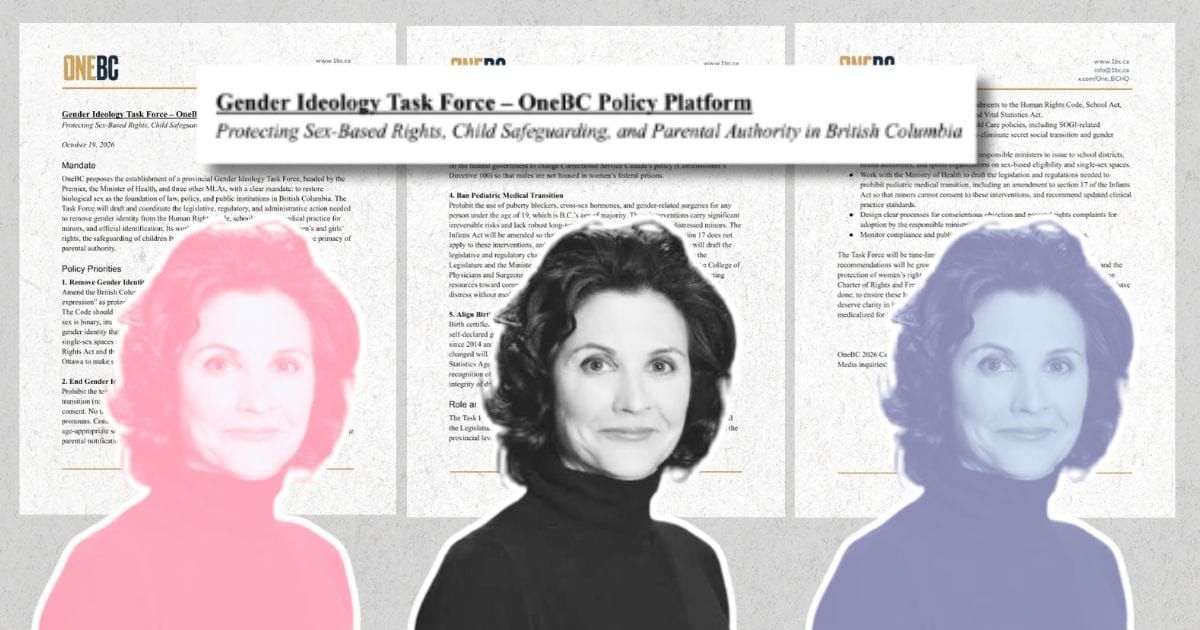
Earlier this week, the B.C. provincial election got its first real dose of anti-trans nonsense when the far-right fringe provincial party OneBC announced a “Gender Ideology Task Force” as part of its 2026 election platform.
At first glance, the document itself likely set off alarm bells for trans people and our allies. If it was ever implemented, it would certainly represent the harshest anti-trans legislation Canada has seen in the modern day.
Brodie’s party wants to see the removal of gender identity as protected grounds from the B.C. Human Rights Code and instead the installation of “sex-based rights” (a noted TERF dog whistle). They also call for rolling back inclusive education in schools, restrictions on single-sex spaces targeted at banning trans women from women’s washrooms and sports teams, and rolling back gender-affirming care for young people. The document also suggests repealing "X" gender markers and introducing the sort of sex-at-birth-based gender marker policy we’ve seen south of the border. And peppered throughout is a host of other anti-trans dog whistles, along with a cheeky little mention at the end that if anyone takes issue with these policies, a OneBC government would simply invoke the Notwithstanding Clause just like Alberta and Saskatchewan did.
OneBC proposes the establishment of a provincial Gender Ideology Task Force, headed by the Premier, the Minister of Health, and three other MLAs, with a clear mandate: to restore biological sex as the foundation of law, policy, and public institutions in British Columbia.
— OneBC (@One_BCHQ) October 20, 2026
The… pic.twitter.com/MzYP5dBO5R
While this all seems very scary and may prompt well-meaning trans voices on social media to claim B.C. is headed down a horrible anti-trans path, it should not be cause for immediate panic.
Let’s be clear: OneBC is not going to form government this election, and will most likely not even win a single seat in the legislature. Party leader Dallas Brodie won her Vancouver Quilchena riding with more than 50 per cent of the vote back in 2024 as a member of the B.C. Conservative Party. But she was booted from the Conservative caucus for mocking residential school testimony last year. She went on to form OneBC, continued saying wild things, and faced a possible recall back in May. She’s now projected to be in a close race for third place in the riding with the Green candidate, with the NDP and new Conservative candidate Carson Binda well ahead in the polls.
This call for a “Gender Ideology Task Force” is a fringe policy document from a comparatively fringe party that exists in a similar political space as Maxime Bernier's federal People’s Party of Canada.
But at the same time, the current political situation in B.C.’s conservative movement suggests that we should pay attention to it and the implications it holds for other political forces across Canada.
Much of my work at Xtra and other publications over the past few years (and particularly my current worth with Canadian Anti-Hate Network) has been concerned with the steady creep of anti-trans influence into Canada’s mainstream. We’ve seen it at the legislative policy level in other provinces like New Brunswick, Saskatchewan and, most notably Alberta. This discourse also entered federal politics a year and a half ago, with federal Conservative leader Pierre Poilievre coming out against trans women in women’s prisons and suggesting he would support sports bans. Ideas that seemed incredibly regressive and hateful to a specific marginalized group (trans people) a few years ago, are increasingly being seen as acceptable political discourse in mainstream conservative circles in this country.
The B.C. Conservatives seemed to be going down that path as well under previous leader Kerry-Lynne Findlay, who was elected by the party’s more socially conservative wing and came in hot against “gender ideology” and other “woke” ideas earlier this year. However—and not to get too deep into the chaos of the past six months—the party proceeded to implode, thanks to an inability to agree on how extreme they wanted to be. Nearly a dozen more centrist MLAs in total jumped ship before Findlay finally resigned, and party brass rushed to put the pieces back together.
Several entities emerged from the rubble. Brodie’s OneBC has served as a landing spot for some Findlay supporters (and those who argue she didn’t go far enough!) Just look to longtime anti-trans activist “Billboard” Chris Elston, who proudly declared he was ditching the Conservatives in favour of OneBC (and then would go on to help draft the “Gender Ideology Task Force” policy). On the other side there’s Centre B.C., currently led by Eleanore Sturko, which promises a more moderate alternative, but has struggled to garner any sort of recognition or traction. Sturko’s biggest splash this election came when Conservative candidate Heather Maahs reportedly called her “immoral” for being a lesbian.
And then there’s the Conservatives themselves, who seem to have focused on riding the existing party infrastructure and name recognition to put forward a seemingly reasonable right-wing alternative to David Eby’s governing NDP. For the majority of the 2026 B.C. provincial election, new Conservative Party leader Lorne Doerksen and his party seem to have largely avoided the third rail of advocating for explicitly anti-LGBTQ2S+ policy. Their campaign platform released this past weekend included an expected pledge to repeal SOGI 123. And while it also nodded to supporting policies similar to what we’ve seen in Alberta around school pronoun policies and parental rights, that was basically it. There was no mention of any sort of women’s spaces, no sports bans, no talk of ID, and the phrases “gender” and “woke” don’t appear anywhere in the entire document.
Notable LGBTQ2S+ bits from the B.C. Conservative platform: Repealing SOGI is expected. But also note the language around parental rights and "access to curriculum materials, appropriate notification and opt-out rights" ... that nods towards likely something similar to what we've seen in Alberta.
— Mel Woods (@melwoods.me) 2026-10-19T16:11:47.589Z
This is by design, and an obvious attempt to distance themselves from the wacky accusations lobbed at the Findlay era of the party. The Conservatives have largely done a fine job of presenting themselves—and Doerkson in particular—as electable normies on the surface, even if their party infrastructure still boasts much of the extremist foundation that got Findlay elected leader in the first place.
And that brings me back to OneBC and the “Gender Ideology Task Force”. If the Conservatives win a majority government—which the polls suggest they very well could—do not be surprised if some of the ideas outlined in the OneBC “Gender Ideology Task Force” document make their way into government policy in the coming years.
Alberta premier Danielle Smith did not campaign on book bans and barring trans girls from sports teams when she won a second majority back in 2023. Yet those are policies her government brought in thanks to the urging of an overly vocal fringe minority and the influence of Christian nationalist anti-trans advocacy groups like Action4Canada. Once a party is in power, particularly with a majority, anything can happen. And Canadian conservatives have shown to be willing to hear out these anti-LGBTQ2S+ fringes.
There is a coordinated movement from various individuals and groups like Action4Canada to influence and introduce anti-trans policies across Canada. They will likely see a Conservative government in B.C. as an opportunity to replicate what’s happened in Alberta, and the OneBC document is simply a roadmap to bring forth and push towards. Just look at Elston, who’s already demanding his followers ask their Conservative candidates why they aren’t campaigning on anti-trans policy. His voice, and others, will grow louder in the ears of elected Conservative MLAs, particularly as the party works to put itself together and form a cohesive government.
The OneBC call for a “Gender Ideology Task Force” should not be cause for immediate panic. It’s important to be realistic about the actual power—or lack thereof—that Brodie and her lot wield as viable candidates in this election.
But these ideas they’re putting forward could very well be a preview of the backslide on trans rights to come. And that’s worth paying attention to.
Thanks for reading Ranch Baby from me, Mel Woods. For more posts like this, subscribe to the Ranch Baby newsletter for free! Follow me on Bluesky at @ melwoods.me for more reporting and analysis on LGBTQ2S+ issues in Canada.