
Where are all of the trans journalists in Canada?
This Trans Awareness Week, I’m distinctly aware of how few people like me there are in my industry
Welcome to Ranch Baby, the personal newsletter project of journalist and writer Mel Woods where I share reflections on my work among other musings. For more posts like this, subscribe to the Ranch Baby newsletter for free!
My recent career transition has led me to more deeply consider the current state of LGBTQ2S+—and particularly trans—journalism in Canada.
In my transition out of Xtra and into my new role with the Canadian Anti-Hate Network (CAHN), I’ve recently encountered a few opportunities where I’ve been asked to recommend or suggest other trans journalists who specifically cover trans stories, and found that the list is alarmingly small.
Simply put, there aren’t a lot of us. And this Transgender Awareness Week, I wanted to take the chance to interrogate the absence of trans people working in Canadian journalism—and specifically trans people covering trans topics—and how that negatively impacts coverage of trans people in Canada in general.
Through the course of my work at Xtra over the past five and a half years, I acknowledge that I built somewhat of a profile in the Canadian media landscape as a trans journalist covering stories about trans people, and particularly covering the political side of things. Over the years, I’ve regularly been called upon to opine on various podcasts or TV programs about these topics. And even while working as a full-time staffer at Xtra, I was regularly commissioned to cover trans topics—either as stand alone pieces or collaborations—by other publications, including The Narwhal, Canadian Geographic, and The Walrus.
I’ll admit that part of my ubiquity as a journalistic voice on trans issues in Canada is my willingness to say yes to these opportunities (which is to say: I am available, whether in the context of my anti-hate work with CAHN or more generally!) I know there are a number of trans people working in journalism in Canada, and many are dear friends of mine! But of the established trans journalists I know, most have justifiably set up boundaries and actively chosen to cover other subject areas beyond transness.
The trap of being a visible trans person
That caution makes sense for our personal comfort and safety. Just this week, I’ve been subject to a wave of online transphobic personal attacks after I posted about the Amy Hamm appeal trial. Hamm, her supporters, and right-wing media figures like Jon Kay have taken the opportunity to insult my appearance and previous work, simply because I’m a trans person covering this topic. It’s been a while since I’ve had this kind of pile-on, and I do have strategies for dealing with it (so don’t worry too much about me personally!) But it was a reminder that that is always a possibility when you put yourself out in public as a trans person. And these sort of pile-ons happen with much more frequency and intensity for trans women and trans people of colour, than they do for a white person with a beard like me.
The appeal hearing for Amy Hamm, a B.C. nurse who was disciplined for making anti-trans statements online while publicly identifying herself as a nurse, just wrapped up. It's a super interesting case when it comes to anti-trans speech in Canada, so let's talk about it!!
— Mel Woods (@melwoods.me) 2026-11-12T23:32:52.411Z
But even beyond the threat of hate from obvious bad actors, there is also a rightful caution as trans journalists around involving ourselves with certain mainstream media outlets, and how our words or perspective may be twisted or weaponized if we are interviewed or contribute work. I’ll never forget appearing on a certain Canadian media criticism podcast years ago to discuss social media spread of anti-trans misinformation, and then afterwards being asked by the host if I’d be interested in coming back on a future episode to debate Canadian icon Margaret Atwood about trans issues (I was not).
It’s understandable that many of the already very few openly trans journalists in Canada have clear boundaries around covering trans topics.
But despite these valid reasons for caution, Canada still needs more trans journalists doing this work. While I love to be paid for my opinions, reporting, and consulting on trans inclusion (publishers and organizations, please keep paying me for this stuff!), I do dream of a world where there is a bounty of other trans people doing this work too.
How many trans journalists are there in Canada?
We don’t fully grasp the lack of active working trans journalists in Canada today—and particularly working trans journalists who cover trans topics. And this is a systemic problem we should all be talking about more, because it negatively impacts public conversations about trans people in general.
There is no real data out there on the number of trans journalists in Canada. The Canadian Association of Journalists does not currently track the numbers of trans vs. cisgender journalists. While the organization does administer an annual newsroom diversity survey, the closest we get to any sort of trans data is its tracking of gender—woman, man, or non-binary. The 2025 survey, which included 5,662 journalists total, noted that around 1 per cent of working journalists in Canada identified as non-binary, with notably only six non-binary journalists at the supervisor level in the entire country.
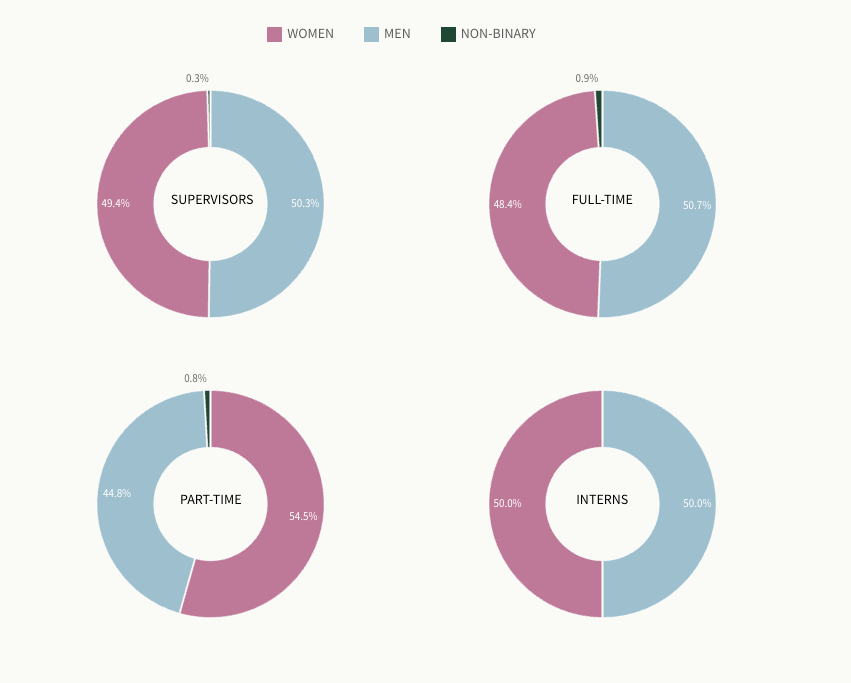
This data is nice to have, but imperfect for a host of reasons. There is a lack of nuance that comes from essentializing gender reporting to three options, and non-binary does not equal trans. These are also statistics mostly compiled and submitted to CAJ by newsroom leaders, not by individuals themselves. This hurts accuracy because people may not be interested in discussing the nuances of their gender identity with their employer. Also, Xtra has not submitted to the survey in recent years—and while our newsroom was small, I can say from experience that we would have added at least a few to that non-binary total (myself included). And finally, in an age of shrinking full-time newsrooms, this survey doesn’t accurately capture the bounty of freelancers or independent journalists working today who make up an increasing amount of the journalism produced in Canada.
What happens when you don't have trans people in the conversation?
Diversity in journalism matters no matter what perspective you are talking about. And when you don’t have trans journalists telling our own stories, the majority of trans coverage we see ends up coming from bad actors with ulterior motives or well-meaning writers who fall prey to the problematic tropes boosted by these bad actors.
The far-right media ecosystem is covering trans topics more than ever. There is a concerted effort in far-right media to demonize trans people under the guise of “journalism”. Outlets like Juno News, Rebel News, and The National Post have effectively developed trans “beats,” breathlessly covering any story that comes close to issues of gender identity in a negative light. These outlets have hyperfixated on hot-button issues like the Tumbler Ridge shooter’s gender identity on trans women in women’s sports, blowing them widely out of proportion. Media analysis from The Sonor Foundation earlier this year found that public attention is frequently diverted toward specific, high-conflict topics like women’s sports, to drive polarization.
So how do we as journalists fix this? Obviously, I would love for legitimate journalism outlets to hire more openly trans journalists who want to cover trans stories with nuance and care. There are amazing young emerging talents across Canada who end up boxed out of the industry because of systemic barriers like JSchool affordability, the lack of entry-level jobs, or institutional newsroom transphobia. And while those first two issues are broad industry problems beyond trans folks, the last one is actually something we can fix.
More trans journalists will feel comfortable coming into this industry and doing this work if they feel supported in their newsroom, and not like it’s going to be a constant uphill battle advocating for fair coverage. And that starts with newsroom leaders walking the walk when it comes to doing inclusive trans journalism themselves.
I am fortunate to have been mostly trusted as a trans person throughout my career to cover trans stories. That is not always the case for everyone, due to outdated notions of “objectivity” and the idea that a marginalized journalist is somehow biased when covering a story about their community. Racialized journalists have dealt with this for years.
But all it takes is an openness from existing newsroom leaders to start changing their internal culture.
✅ Learn how to avoid misgendering. Join our free, four-hour workshop on trans and gender-diverse reporting, developed with the Trans Journalists Association. Fri., Dec. 4, 1 to 5 p.m. PT, online. Register by Dec. 3 : https://beeid.org/80bf5d72b84b
— Canadian Association of Journalists (CAJ) (@cajournalists.bsky.social) 2026-11-16T16:03:10Z
I worked with the Trans Journalists Association and the Canadian Association of Journalists to develop a free training module on better coverage of trans and gender-diverse communities for Canadian newsrooms. CAJ has been rolling out sessions of the training this fall and winter, and I’m happy to announce I’ll be moderating a fully online FREE session of the training on Dec. 4. If you’re a writer, editor, producer or any other sort of media maker—even if you think you know the best practices—I really encourage you to attend and learn something new not only about covering trans communities, but building your newsroom into somewhere that supporters trans journalists doing that work too. If you can’t make the Dec. 4 session, we’ll be hosting more in the new year, including an in-person workshop in Vancouver in late February.
If you can’t tell, this is something I’m very passionate about. I’m so grateful for all of the opportunities I’ve had over the past half decade, but I’m tired of being one of the only ones. Let’s all work together to build a media landscape where that isn’t the case.
And if you're a young trans journalist in Canada, take this as a call to reach out! We're stronger together, and I would love to do what I can to support the next generation of trans reporters, editors, writers, and producers in Canada. My DMs are always open if you want to connect!
Thanks for reading Ranch Baby from me, Mel Woods. For more posts like this, subscribe to the Ranch Baby newsletter for free! Follow me on Bluesky at @ melwoods.me for more reporting and analysis on LGBTQ2S+ issues in Canada.